
Lessons in workplace communication with Liz Atkin

Communication sits at the heart of every successful business, but in today’s workplace, connecting people across different generations has never been more important.
In this edition of Nuwsletter, we sit down with Liz Atkin, Director of Refreshing Comms, TEDx speaker and author, to explore how better communication can transform organisations, strengthen leadership, and create cultures where people thrive.
Drawing on years of experience helping businesses align people, purpose and strategy, Liz shares her insights on leading through change, bridging generational differences, and why the strongest leaders are often the best communicators.
Whether you’re leading a team, growing a business or simply looking to communicate with greater impact, this conversation offers practical lessons that extend far beyond the workplace.
Get to know Liz Atkin
- Based: Teesside
- My Favourite Business Book: Alchemy, by Rory Sutherland
- My Podcast Recommendation: Anything that expands the mind
- My Business Hero: Napoleon Hill
- If I wasn’t a business owner I would of been: A marketer or a therapist
- Outside of the office you can find me: In my garden, reading a book or listening to a podcast
What first drew you to the world of workplace communication, and what inspired you to start Refreshing Comms?
Let’s call it a ‘bridge of incidents’ that led me to where I am now. You’ll have heard of zig-zag or squiggly careers where there was never one defining goal or direction, just a series of opportunities that fit well at the time. Well that’s me. Not very entrepreneurial but true!
I guess the first trigger was when (having built-up 15 years of third sector experience) I took on the position of CEO in a small organisation where I thought I’d ‘cut my executive teeth’ before moving on to leading bigger organisations. I was both right and wrong. My naivety (cringe) was to think that just because I was energised, excited and geared up to improve and transform this organisation, the employees would also follow suit. They did not. In fact I learned very quickly that I’d parachuted into a highly toxic and resistant environment. Sure, I’d done due diligence in terms of looking at governance, accounts, plans etc. But I had not really given any thought to the people I’d be leading or the culture that I’d inherit. To quote Charles Dickens, “it was the best and worst of times”. Best, because I never learned so much so fast about people. And worst because by the time I finished my tenure there, I was so drained that I had to take 3 months out to recover!
This bridge of incidents then led me into 10 years of working in a business improvement training and culture change consultancy, where I visited literally hundreds of companies up and down the UK and talked to MDs, CEOs, Ops Directors, HR Directors, Change Leads and so on. It made for fascinating learning. Ostensibly, my role was to discuss and advise on operational improvement and efficiency needs, but I found that across the board these clients would use the hour they had with me to open up / vent / agonise over people issues – and these problems always turned out to be rooted in misalignment, silos and misunderstandings caused by – guess what – poor communication and lazy assumption.
These issues – that took up a significant amount of their time and headspace – were so universally common, no matter what the nature of business, that after a decade of hearing the same things, I felt compelled to write a book (as you do) – and called it ‘Refreshing Comms’ which gained several endorsements. Then, I built my business on the back of that – developing and refining as I went along – as I still do. For example, my TEDx talk on intergenerational connection (a passion of mine) got quite a bit of traction and led to intergenerational workforce strategy becoming a key part of my business offering.
You often talk about connecting people, purpose and strategy. Why do so many organisations struggle to align all three?
Because these three things – people, purpose and strategy – are typically dealt as separate things and then thrown together and expected to work harmoniously, without any real thinking behind them.
When an organisation treats people ‘stuff’ as the sole domain and responsibility of HR, when purpose is just something that sits in a vision, mission and values statement, and when strategy development, and the thinking behind it, tends to stay at C-suite level – then you’re not going to get the connection you need and the outcomes you’d ideally want.
Also, without the wraparound, intentional communication needed to support, drive and embed effective working and the achievement of business goals, things fall short of their potential, making any kind of progress feel more like an uphill struggle.
So when I talk about connecting people, purpose and strategy it’s because in my experience, many organisations don’t take the time to ‘join the dots’ for people, and they’ve often lost sight of the basic fundamentals of what makes people tick – once you understand that, you’re on a much surer footing for creating a more engaged, collaborative and resilient workforce.
What is the biggest communication mistake leaders make without realising it?
There are lots of common pitfalls when it comes to communication mistakes. But the overriding one is when leaders see information and communication as being the same thing. In fact there’s a big difference: information is ‘giving out’, communication is ‘getting through’.
And to get through to people, for a message to resonate and have the desired effect, its content needs to be written in a way that connects with the audience on both an emotional and intellectual level. That’s the way to be effective, and is far more likely to land well. The assumption that information sent equals message received, accepted and understood, is a flawed one.

What can younger and older generations learn from each other regarding workplace communication?
There are many things younger and older generations can learn from each other – and communication is right at the heart of making that possible. Firstly, it’s worth acknowledging that the need for good, effective and helpful communication is not tied to any one generation. We all want it and appreciate it, whatever our age or role.
That said, there are some challenges that are holding many younger (Gen Z) employees back on the communication front. For several (well documented) reasons, many young people are entering the workforce lacking the confidence and social skills that more seasoned and experienced workers take for granted. So the ability to establish themselves and start building good working relationships is often missing, and can be misinterpreted as negative behaviour and attitude. This is just one example of several generational differences that – if not addressed well – leads to the reinforcing of stereotypes, bias and division both ways.
Overall, both younger and older generations bring different strengths to workplace communication, and the most effective organizations create environments where both perspectives are valued rather than treated as competing styles or as either right or wrong.
One of the main things younger workers can learn from their older, more life-experienced colleagues is that communication at work is often about relationships, not just exchanging information. A quick message may solve an immediate problem, but strong working relationships often require conversations, context, and follow-through. Knowing how to handle sensitive situations is important too – for example when a face-to-face or phone conversation is more appropriate than a text or an email. Also, it’s good to learn that disagreements don’t always require an immediate response, and that patience and diplomacy, as valuable skills, can help greatly in tricky situations.
For older generations, younger colleagues can provide valuable, alternative perspectives, such as their preference for straightforward communication and clear expectations which can reduce misunderstandings and accelerate decision-making. They can also show how digital communication is a legitimate skill and how modern tools can support collaboration and management of distributed teams for example. Younger people’s expectations and drive for organisational transparency, openness and feedback can shine a light on certain leadership and working practices where this may be lacking, and open up possibilities for improvements that all generations and levels of hierarchy can benefit from.
So you can see that it’s not a case of who is right and who is wrong – just differences to learn from and capitalise on.

How has your approach to leadership evolved throughout your career?
My younger-self was never interested in leadership, and thought it way beyond my capability anyway. That started to change when I realised I was becoming very good at certain things, and opportunities were being offered to me. However, my early days of managing people felt a bit uncomfortable and so I stuck by the book a lot, even when my gut instinct told me otherwise. I guess I just didn’t have the confidence or belief in my own judgement.
Today – older and wiser – it’s actually my gut instinct, my own judgement, that I rely on most. I can pretty much connect the worst decisions I’ve made to those times when I’ve ignored my gut feel. So I’d say that’s been the major, defining change.
I’d also say that my approach is far more relaxed and authentic to me. I only do what a) interests me and b) makes a positive difference to others. The early-career need for validation and playing by the rules, has been replaced by a much healthier enjoyment for trying new things and experimenting with ideas – having learned that there’s no such thing as failure, just more lessons learned. It’s also important to me to keep on improving my understanding of myself and others – I’d describe it as having a ‘constant curiosity’ that helps me to keep developing and refining my leadership thinking and approach.
What separates organisations with strong cultures from those that constantly struggle with engagement?
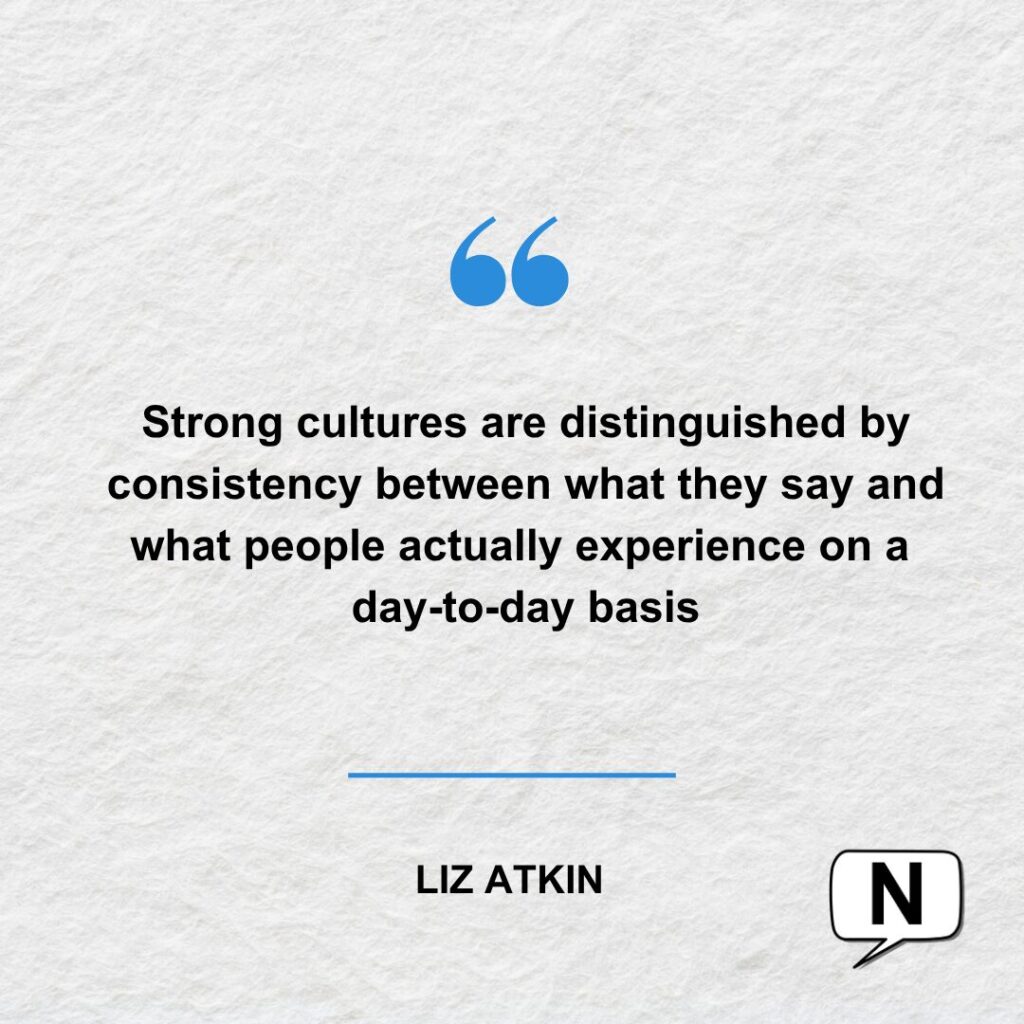
Strong cultures are distinguished by consistency between what they say and what people actually experience on a day-to-day basis. They’ve built trust this way. Their leaders model the desired culture through their own behaviour and communication – and they’re good at explaining the why, not just the what, who, how and when. It’s absolutely true that engagement rises when people can see and feel how their work contributes to something
meaningful, and this is achieved by communicating purpose repeatedly and connecting individual work to broader goals. They also tend to be very good at developing their managers – engagement problems are often management related, and this is important to note because managers tend to have the greatest influence on an employee’s experience.
Also, time is regularly made for recognition and celebration – a workplace should not be joyless! And ultimately, organizations that excel at engagement view culture as a strategic asset, not an HR initiative.
The organisations who struggle with engagement are typically those that are either not doing any of these things, or are trying some but not in the right way. And you usually find that they’re operating in a rather fragmented and inconsistent way which is hard for people to engage with in the first place.
In an age of constant digital communication, do you think we’re becoming better or worse at genuinely connecting with people?
Such an important question. I think that this increasing dependence on using digital technology to communicate is undermining our ability to connect and understand each other. Sure we can reach people instantly 24/7 anywhere in the world in a variety of clever ways, but should communicating with each other be all about speed and efficiency? If you ask the question “what does genuinely connecting with people feel like?” (because human connection is an emotional not a logical experience) then we’d bring to mind those conversations that left us feeling something good, making it memorable and satisfying.
And this topic plays straight into the bias and assumptions that many older workers (who learned how to communicate and connect without the aid of digital technology) have about younger generations being uncommunicative. It’s really not surprising when you acknowledge that they’ve known nothing else but a digitally driven world, and many started work during a pandemic that made working alone and relying on technology the norm.
We’ll never lose digital communication from our lives – and nor should we, these tools are part of how we live and offer lots of advantage – but I believe there’s an even stronger argument for creating intentional space and opportunity for more human-to-human, younger-to-older, in- person conversation and connection – be that in the workplace or in our personal lives.
Was there a moment in your career that fundamentally changed how you think about business or leadership?
Not so much a ‘moment’ per se, but a piecing together of insight and lived experience that formed one indisputable fact: if people aren’t connected to and happy in their work – then the work (inputs, outputs and outcomes) will never be as good as it could be, and people’s individual and team potential will never be fully realised. You might say that’s a simplistic view of things, and it is – but nothing is more true.

If you could give one piece of advice to founders looking to build a high-performing team, what would it be and why?
Be intentional about who you reward, promote and tolerate because people will pay far more attention to what you reinforce than to what you say. You can talk about innovation, collaboration, accountability, customer focus, or ownership all day long. But if you reward people who hit numbers while damaging teamwork, miss commitments without consequences, or undermine company values, your people will quickly learn what really
matters. I learned that a good question to ask yourself is “If a new employee watched our leadership team for a month, what would they conclude is truly valued here?”
What does success mean to you today compared to when you first started your career?
When I think back to my early career, success was all about me, what I could get from my job – things like money, and validation from others. Today, success is knowing I’m making a meaningful and practical difference where it matters, and building and enjoying great working relationships. I no longer seek validation from people because I believe wholeheartedly in what I do and how I do it. It’s a very liberating position to be in and strangely enough, brings me even more opportunity for success, fulfilment and relationships than my younger self could have ever hoped for.
Read more interviews
 Interview
Lisa Johnson interview
In this edition of Nuwsletter, we sit down with Lisa Johnson, a leading entrepreneur known for…
 Interview
A masterclass in ambition and resilience
Michelle Niziol’s journey is a masterclass in ambition, resilience, and building on your own terms. As…